

In 2015, PPC was a game of control. Marketers chose keywords, adjusted bids manually, and optimized campaigns with spreadsheets. If you understood match types and account structure, you could dominate performance.
But that era is over.
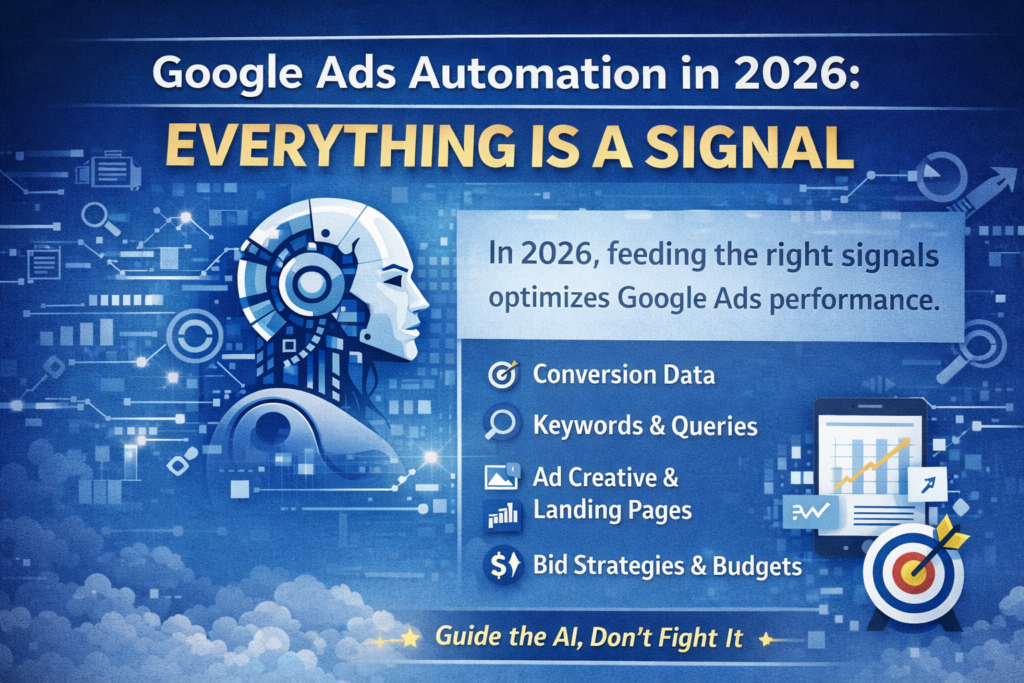
In 2026, Google Ads automation is not just a feature. It is the engine that drives results. Algorithms decide bids, audiences, and placements at a scale no human can match. The real skill today is not manual optimization, but understanding how signals shape automation.
Signals are the data points that teach Google what success looks like. When signals are strong, automation performs brilliantly. When signals are weak, automation scales mistakes. This shift has changed how marketers think, plan, and compete.
How Automation Became the Core of Google Ads Performance
From manual PPC to algorithm-driven campaigns
In earlier years, marketers relied on manual bidding, keyword segmentation, and strict budgets. Performance depended on how well campaigns were structured. However, automation has replaced most of these tasks. Smart bidding, Performance Max, and AI-driven targeting now dominate campaign management.
Why fighting automation no longer works
Many marketers still try to control every detail. However, automation evaluates billions of signal combinations in milliseconds. Humans cannot compete with that speed or complexity. Therefore, the goal is no longer control but guidance.
The new role of marketers in 2026
Marketers are no longer operators. They are signal architects. Their job is to define what success means, feed accurate data, and protect signal quality. As a result, strategy has replaced manual execution as the main competitive advantage.
What Actually Counts as a Signal in Google Ads
Signals beyond audience targeting
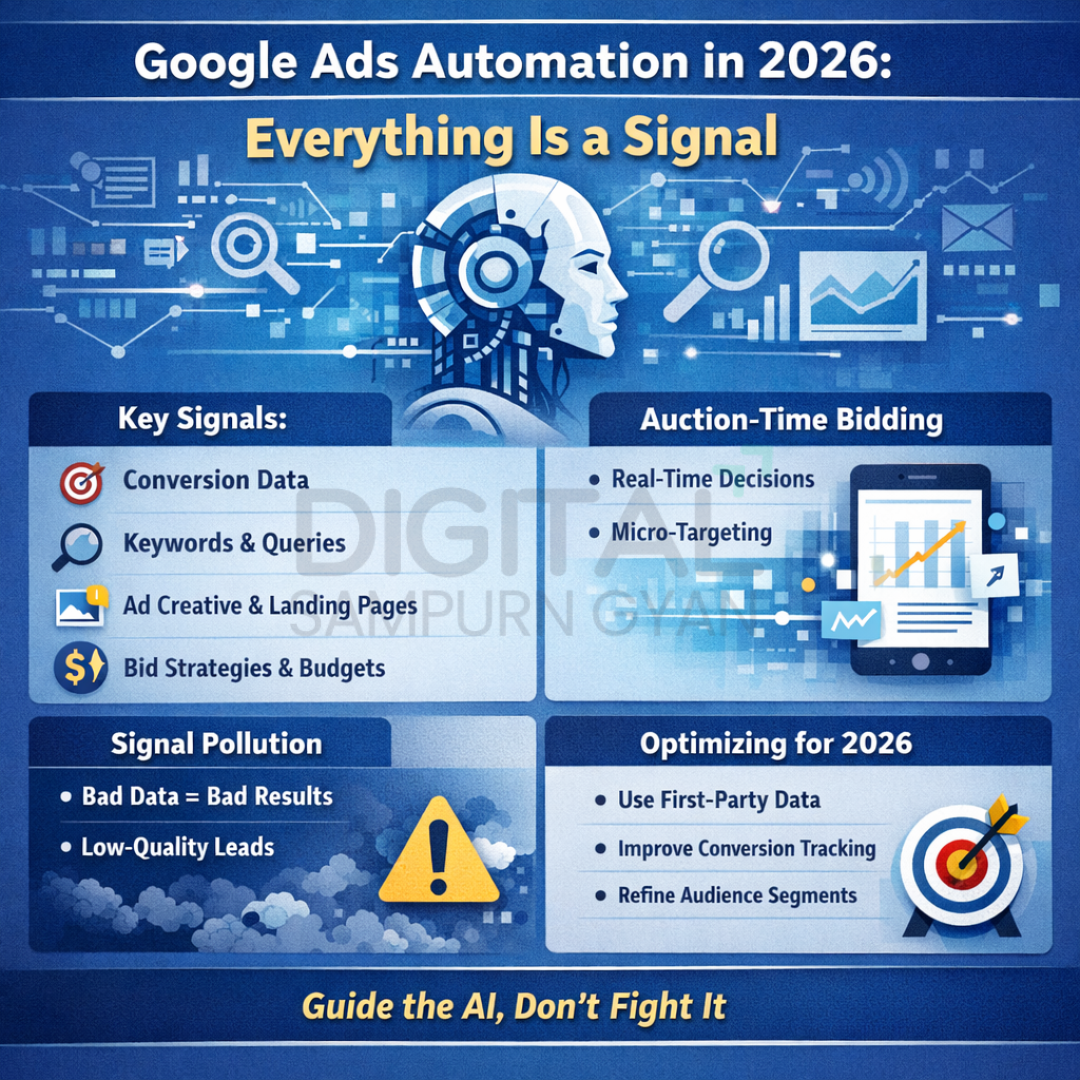
Google often describes audience signals as demographic or interest-based segments. However, this definition is incomplete. In reality, everything inside a Google Ads account acts as a signal. Structure, creatives, landing pages, budgets, and conversion tracking all influence how automation learns.
Core signal categories shaping performance
Conversion actions and values are the most critical signals. They tell Google which outcomes matter. Keyword signals define intent and semantic context. Creative signals influence who clicks and why. Landing page signals show whether user expectations are met. Bid strategies and budgets reveal how aggressively you want to grow.
The ecosystem of behavioral and structural signals
Signals come from multiple layers. Real-time search behavior, feed quality, pacing patterns, and engagement metrics all shape the algorithm’s understanding of intent. Therefore, nothing in an account is neutral. Every element teaches the system who to target and what to optimize.
The Auction-Time Reality: How Google Finds “Pockets” of Performance
Why modern bidding is not keyword-based anymore
Google does not set one bid for a keyword. Instead, it calculates a unique bid for every auction. It considers user behavior, device type, location, time, and historical interactions. For example, a user browsing on mobile at night after visiting your pricing page receives a different bid than a casual searcher.
From broad averages to micro-level predictions
Traditional PPC looked for clear winners and losers. Modern automation searches for pockets of performance. These are combinations of signals where users are most likely to convert. As a result, campaigns become more precise but also more dependent on data quality.
The “garbage in, garbage out” problem
Automation cannot fix bad data. If signals are misleading, the algorithm guesses incorrectly. Therefore, marketers must ensure that every signal reflects real business value. Without quality signals, even the best automation produces weak results.
The Signal Hierarchy: What Google Ads Listens to Most
Conversion signals as the foundation
Conversion tracking is the most powerful signal. Google needs consistent conversion data to learn patterns. For many businesses, this means importing offline conversions from CRM systems. Optimizing for qualified leads instead of raw clicks ensures automation targets real value.
First-party data and enhanced conversions
Third-party cookies are disappearing. As a result, first-party data has become essential. Customer lists, enhanced conversions, and server-side tracking provide reliable signals. Without them, automation loses visibility into true performance.
Contextual and creative signals
Visual elements in ads and landing pages also act as signals. Images, messaging, and design cues help Google infer audience profiles. For example, luxury visuals attract high-end users. Similarly, landing page speed and design influence trust and relevance.
Understanding signal weight
Not all signals are equal. Primary signals like conversion value and offline data shape the core model. Secondary signals like audience lists and creative context refine targeting. Tertiary signals like long-tail keywords and landing page behavior provide additional context. Meanwhile, soft conversions often act as noise rather than value.
Signal Pollution and Algorithm Drift: The Hidden Threats
What signal pollution really means
Signal pollution happens when low-quality data enters the system. Junk leads, irrelevant clicks, and mixed-intent campaigns confuse automation. Instead of targeting ideal customers, the algorithm learns to chase cheap interactions.
Common sources of polluted signals
Bad conversion tracking, overly broad structures, misleading creatives, and mismatched audiences are major causes. In addition, budget patterns that favor volume over quality distort the system’s understanding of success.
How algorithm drift develops over time
Drift occurs when automation gradually optimizes toward the wrong outcomes. It does not happen suddenly. It appears as declining lead quality, irrelevant search terms, or inflated metrics that do not match revenue. Therefore, marketers must monitor performance beyond surface-level dashboards.
Correcting drift without breaking learning
The solution is not to reset campaigns. Instead, marketers should tighten conversion signals, refresh audience data, isolate intent through structure, and realign creatives. After corrections, the system needs time to stabilize. Overreacting creates more confusion and delays recovery.
Building a Signal Strategy That Works in 2026
Align signals with real business outcomes
For lead generation, offline conversion imports connect ads to actual revenue. For ecommerce, value-based bidding differentiates between low- and high-margin products. Therefore, signals must reflect profit, not just activity.
Segment data intelligently
Not all data belongs in one pool. Recent buyers are more valuable than old visitors. Brand and non-brand traffic behave differently. High-ticket and low-ticket products require separate strategies. Mixing them distorts signals and misguides automation.
Centralize when signals belong together
Automation performs best with enough data. However, centralization only works when signals are aligned. Campaigns should be consolidated when audiences, price points, and intent are similar. When they are not, separation protects signal clarity.
Turning signals into a competitive advantage
In 2026, automation is available to everyone. The real differentiator is signal quality. Marketers who protect signals, diagnose pollution early, and guide algorithms strategically gain long-term leverage. Instead of fighting automation, they use it as a growth engine.
FAQs About Google Ads Signals and Automation in 2026
1. What are signals in Google Ads automation?
Signals are data points that help Google understand user intent and campaign goals. They include conversions, audiences, keywords, creatives, landing pages, and behavior patterns. These signals guide bidding, targeting, and ad delivery decisions.
2. Why are conversion signals the most important in 2026?
Conversion signals define success for the algorithm. When conversions reflect real revenue or qualified leads, automation learns correctly. If conversions are inaccurate or low quality, the system optimizes toward the wrong outcomes.
3. How does signal pollution affect Google Ads performance?
Signal pollution happens when irrelevant or low-quality data enters the system. It trains the algorithm to target the wrong users. As a result, campaigns may generate cheap clicks but low business value.
4. What is algorithm drift in Google Ads automation?
Algorithm drift occurs when automation gradually shifts toward low-intent audiences or irrelevant queries. It often shows up as declining lead quality or mismatched revenue data. Early detection helps prevent long-term performance decline.
5. How can marketers improve signal quality in Google Ads?
Marketers should refine conversion tracking, use first-party data, separate campaign intent, and update creatives. Regular audits and data segmentation also help automation learn from accurate signals.
6. Are keywords still relevant in automated Google Ads campaigns?
Keywords still matter but play a supporting role. They provide semantic context and intent signals. However, automation relies more heavily on user behavior, conversions, and audience data than on keywords alone.
7. How does first-party data influence Google Ads automation?
First-party data provides reliable insights into customer behavior. It helps Google model similar audiences and optimize targeting. With privacy restrictions increasing, first-party data has become a critical signal for performance.
8. What is the biggest competitive advantage in Google Ads in 2026?
The biggest advantage is signal quality. When automation receives accurate, high-value signals, it delivers better results than manual optimization. Marketers who understand and protect signals outperform competitors in automated environments.