
Digital marketing has changed fast over the past few years. What once took a full team and long hours can now be done in minutes with the help of AI tools. But here’s the truth: AI is not magic. It’s powerful, yes. But it works best when guided by human thinking.
If you’re a business owner, marketer, freelancer, or student trying to understand how AI fits into marketing, this guide is for you. I’ve worked in content and digital strategy for over a decade. I’ve seen trends rise and fall. AI is not just another trend. It’s a shift in how we work.
This is your complete, beginner-friendly roadmap to using AI in digital marketing the right way in 2026.
What Is AI in Digital Marketing?
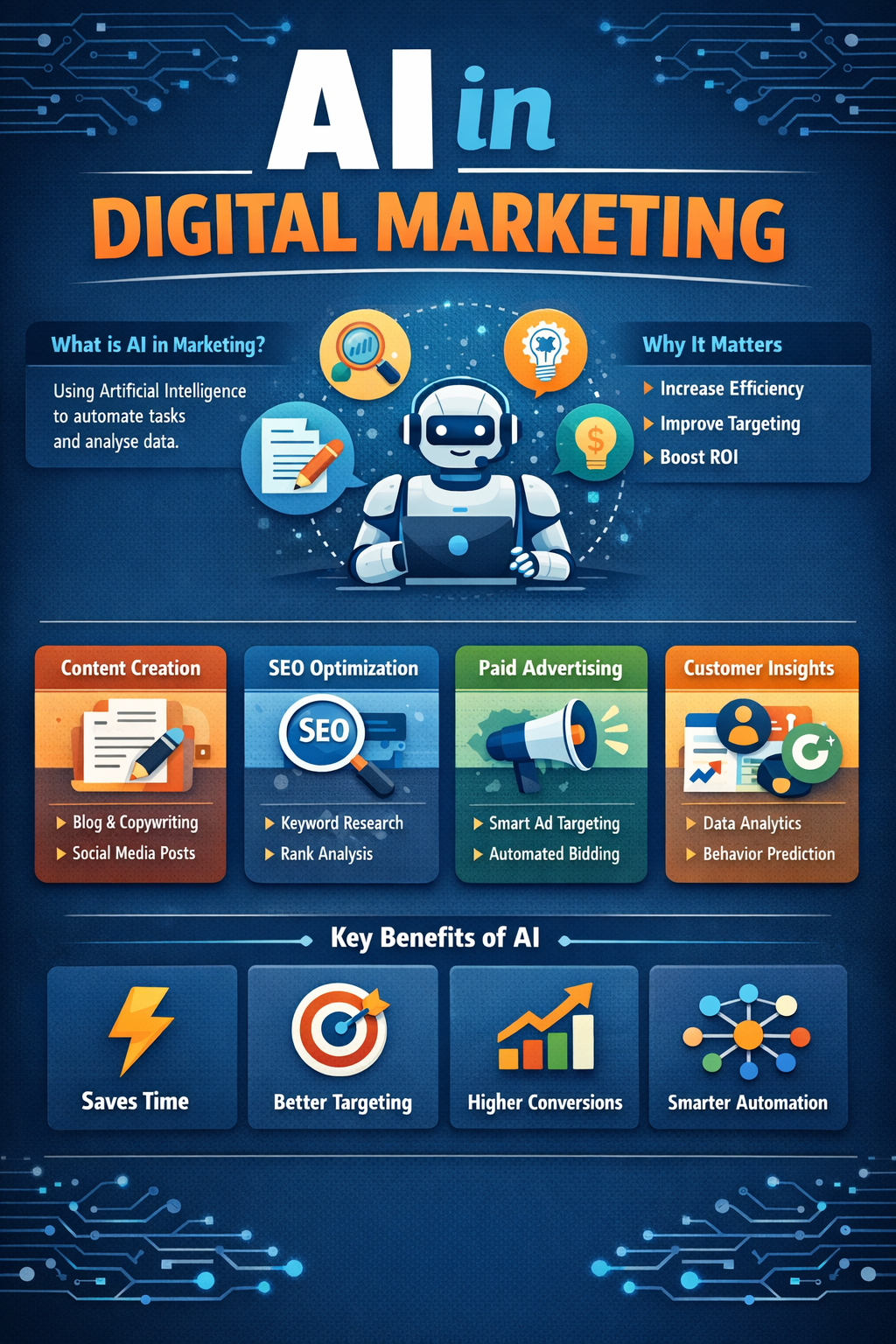
AI (Artificial Intelligence) in digital marketing means using smart software to automate, analyze, and improve marketing tasks.
Think of it like this:
-
Instead of guessing what your audience wants, AI analyzes data.
-
Instead of writing from scratch, AI helps generate drafts.
-
Instead of manually sending emails, AI personalizes them automatically.
But AI does not replace marketers. It supports them.
It can:
-
Analyze customer behavior
-
Predict trends
-
Write content drafts
-
Optimize ads
-
Improve SEO
-
Automate campaigns
The human role? Strategy, creativity, decision-making, and brand voice.
Why AI Matters More in 2026
In 2026, competition is higher than ever. Content is everywhere. Attention spans are short. People expect personalized experiences.
AI helps marketers:
-
Work faster
-
Make better decisions
-
Reduce manual work
-
Improve targeting
-
Save money
For example, if you run an online clothing store, AI can:
-
Suggest products customers might like
-
Predict which products will trend next season
-
Send emails based on browsing behavior
-
Adjust ad budgets automatically
Without AI, you’d need hours of manual analysis. With AI, you get insights in seconds.
The Pillar Strategy: AI in Digital Marketing
To truly understand AI in marketing, we break it into clusters. This helps you build knowledge step by step.
Here’s the content cluster structure we’ll follow:
-
40+ AI Tools for Digital Marketers
-
20+ Marketing Automation Tools Explained
-
15+ AI SEO Tools to Rank Faster
-
25+ ChatGPT Prompts for Marketing
-
15 AI Content Mistakes to Avoid
Each section builds on the previous one.
40+ AI Tools for Digital Marketers
AI tools are everywhere. New ones launch every month. It’s easy to feel overwhelmed.
Let’s simplify.
Categories of AI Tools Marketers Use
1. Content Creation Tools
These help write blog posts, social media captions, email drafts, ad copy, and product descriptions.
They:
-
Generate ideas
-
Create outlines
-
Rewrite content
-
Improve grammar
-
Suggest headlines
Example: If you’re stuck writing Instagram captions, an AI tool can generate 20 options in seconds.
But remember, always edit before publishing.
2. SEO Tools
AI-powered SEO tools help with:
-
Keyword research
-
Competitor analysis
-
Content optimization
-
Technical audits
They analyze search data and tell you what people are looking for.
For example, instead of guessing keywords for “healthy cooking oil,” AI shows search volume, difficulty, and related terms.
3. Advertising Tools
AI improves:
-
Audience segmentation
-
Budget allocation
If one ad performs better, AI automatically shifts more budget toward it.
This saves money and improves ROI.
4. Design and Creative Tools
You don’t need to be a graphic designer anymore to create visuals.
AI can:
-
Generate images
-
Create thumbnails
-
Suggest layouts
-
Resize creatives automatically
This is helpful for small businesses with limited resources.
5. Analytics and Data Tools
Data can be confusing. AI makes it easier.
Instead of reading complex dashboards, AI highlights:
-
What’s working
-
What’s not
-
Where you’re losing conversions
It turns raw numbers into clear insights.
How to Choose the Right AI Tool
Ask yourself:
-
What task takes the most time?
-
Where do I struggle?
-
Do I need content, data, or automation support?
Don’t buy every tool. Start small. Test one. Then expand.
20+ Marketing Automation Tools Explained
AI and automation often work together.
Automation means setting up systems that run without constant manual input.
What Is Marketing Automation?
It’s software that:
-
Sends emails automatically
-
Scores leads
-
Nurtures prospects
-
Schedules social posts
-
Tracks user journeys
Imagine this scenario:
A visitor downloads your free ebook.
They automatically receive:
-
A welcome email
-
A follow-up email after 2 days
-
A discount offer after 5 days
You didn’t manually send those emails. The system did.
Types of Marketing Automation
Email Automation
Triggered emails based on actions:
-
Abandoned cart
-
Signup confirmation
-
Birthday offers
This increases conversions without extra effort.
CRM Automation
CRM tools track:
-
Customer interactions
-
Sales stages
-
Communication history
Sales teams know exactly where each lead stands.
Social Media Automation
You can schedule posts for:
-
Facebook
-
Instagram
-
LinkedIn
-
Twitter
It saves time and keeps your posting consistent.
Lead Nurturing Automation
AI helps send the right content to the right person at the right time.
For example:
If someone reads your SEO blog, they might receive an email about SEO tools next.
That’s smart targeting.
15+ AI SEO Tools to Rank Faster
SEO is not guesswork anymore. AI has made it data-driven.
How AI Helps SEO
AI can:
-
Find ranking gaps
-
Analyze competitors
-
Suggest content improvements
-
Optimize internal linking
-
Identify technical errors
Let’s break it down.
Keyword Research
Instead of manually checking search volume, AI tools:
-
Show related keywords
-
Suggest long-tail variations
-
Predict ranking chances
If you target “AI marketing tools,” AI may suggest:
-
Best AI marketing tools for small business
-
Affordable AI marketing software
-
Free AI tools for beginners
That’s smarter targeting.
Content Optimization
AI tools analyze top-ranking pages and suggest:
-
Word count
-
Headings
-
Semantic terms
-
FAQ ideas
It’s like having a content coach.
Technical SEO
AI can detect:
-
Broken links
-
Slow-loading pages
-
Missing meta tags
-
Duplicate content
It makes site audits faster and clearer.
25+ ChatGPT Prompts for Marketing
AI tools are powerful. But prompts matter.
The better your input, the better the output.
Why Prompts Are Important
Think of AI like an intern.
If you give vague instructions, you get vague results.
If you give clear instructions, you get better work.
Types of Marketing Prompts
Blog Writing Prompts
-
“Create a 1500-word beginner guide on email marketing.”
-
“Write a SEO-friendly blog outline for digital advertising.”
Ad Copy Prompts
-
“Write 5 Facebook ads for a skincare brand targeting women 25-35.”
-
“Create Google ad headlines under 30 characters.”
Email Marketing Prompts
-
“Write a welcome email for new subscribers.”
-
“Create a 3-email sequence for product launch.”
Social Media Prompts
-
“Write 10 Instagram captions for a fitness coach.”
-
“Create LinkedIn post ideas about AI in marketing.”
Pro Tip for Better Prompts
Add:
-
Target audience
-
Tone
-
Goal
-
Word count
-
Platform
Example:
“Write a friendly but professional LinkedIn post (150 words) for small business owners explaining how AI saves marketing time.”
See the difference?
15 AI Content Mistakes to Avoid
AI is helpful. But mistakes can hurt your brand.
Let’s talk honestly.
1. Publishing Without Editing
AI drafts are not final versions.
Always:
-
Check facts
-
Improve flow
-
Add brand voice
-
Remove generic lines
2. Overusing AI
If everything sounds robotic, people notice.
Mix human storytelling with AI support.
3. Ignoring SEO Structure
AI content still needs:
-
Headings
-
Internal links
-
Meta descriptions
-
Clear formatting
4. No Personal Experience
Google values experience.
Add:
-
Case studies
-
Real examples
-
Personal insights
5. Keyword Stuffing
Don’t force keywords into every sentence.
Write naturally.
6. Blindly Trusting AI Facts
AI can make mistakes.
Verify statistics before publishing.
7. Using the Same Prompt Repeatedly
Change prompts to avoid repetitive tone.
8. No Clear Strategy
AI without strategy leads to random content.
Plan topics first.
9. Ignoring Brand Voice
AI doesn’t know your brand unless you guide it.
Train it with examples.
10. Thinking AI Replaces Humans
It doesn’t.
It enhances human capability.
How to Build a Smart AI Marketing System
Here’s a simple structure:
Step 1: Use AI tools for research
Step 2: Use prompts for content drafts
Step 3: Optimize with AI SEO tools
Step 4: Automate distribution
Step 5: Analyze performance
Repeat and improve.
The Future of AI in Digital Marketing
AI will become:
-
More personalized
-
More predictive
-
More integrated
But one thing won’t change.
People buy from brands they trust.
Trust comes from:
-
Clear communication
-
Authentic voice
-
Helpful content
AI can assist. Humans build relationships.
How AI Is Used in Digital Marketing
AI supports many areas of digital marketing. Let’s break them down clearly.
1. AI for Content Creation
Content marketing remains one of the strongest growth strategies. Blogs, emails, landing pages, and social media posts all drive traffic and sales.
AI tools can:
-
Generate blog outlines
-
Suggest headlines
-
Draft email campaigns
-
Rewrite content for clarity
-
Create product descriptions
For instance, if you need 10 Instagram captions for a fitness coach, AI can generate them in seconds. You can then edit them to match your brand tone.
Still, human editing is critical. AI drafts save time, but they need refinement.
2. AI for SEO (Search Engine Optimization)
SEO is no longer just about keywords. It involves search intent, user experience, and technical health.
AI-powered SEO tools help with:
-
Keyword research
-
Competitor analysis
-
Content gap identification
-
On-page optimization
-
Technical audits
For example, instead of manually checking ranking pages, AI can analyze the top 10 results and suggest:
-
Recommended word count
-
Important subtopics
-
Related search queries
-
Internal linking ideas
This reduces guesswork and improves ranking chances.
3. AI for Paid Advertising
Paid ads on Google, Facebook, and other platforms already use AI algorithms.
AI helps marketers:
-
Optimize bidding strategies
-
Identify high-converting audiences
-
Test multiple ad variations
-
Adjust budgets automatically
Suppose one ad campaign performs better than others. AI systems automatically increase spending on that campaign and reduce spending on low performers.
As a result, ROI improves.
4. AI for Email Marketing
Email marketing remains highly profitable. AI makes it smarter.
AI can:
-
Segment subscribers automatically
-
Personalize subject lines
-
Predict the best sending time
-
Trigger behavior-based emails
For example, if a customer adds a product to the cart but does not purchase, AI triggers an abandoned cart email.
This increases conversions without manual effort.
5. AI for Customer Insights and Analytics
Data is powerful, but raw numbers can be confusing.
AI tools analyze large datasets and highlight:
-
What is working
-
What is underperforming
-
Where conversions drop
-
Which audience segments convert best
Instead of spending hours analyzing reports, marketers get clear insights quickly.
Frequently Asked Questions (FAQs)
1. Is AI replacing digital marketers?
No. AI assists marketers but does not replace strategy, creativity, or decision-making.
2. Is AI-generated content good for SEO?
Yes, if edited properly and aligned with E-E-A-T guidelines. Purely automated content without human review may perform poorly.
3. Do small businesses need AI tools?
Yes. Even small businesses benefit from AI for content, email automation, and analytics. Start with basic tools and scale gradually.
4. How many AI tools should I use?
Focus on 2–3 essential tools first. Too many tools create confusion and increase costs.
5. Is AI marketing expensive?
Not necessarily. Many tools offer affordable plans. The key is choosing tools that match your business goals.
Final Thoughts
AI in digital marketing is not about replacing creativity. It’s about removing friction.
It saves time.
It improves decisions.
It helps scale faster.
But strategy still comes from you.
If you use AI wisely, you’ll:
-
Work smarter
-
Rank better
-
Convert more
-
Reduce stress
Start simple.
Test tools carefully.
Edit everything.
Focus on value.
That’s how you win in digital marketing in 2026.