

Artificial Intelligence has completely changed the way we create content. Today, bloggers, agencies, and businesses use AI tools developed by companies like OpenAI, Google, and Microsoft to speed up writing.
However, speed does not guarantee quality.
After working in SEO and content marketing for more than a decade, I have seen one clear pattern: websites that depend blindly on AI often struggle with rankings, trust, and conversions. On the other hand, websites that combine AI with human expertise grow faster and build authority.
So, what is the difference?
It comes down to avoiding critical mistakes.
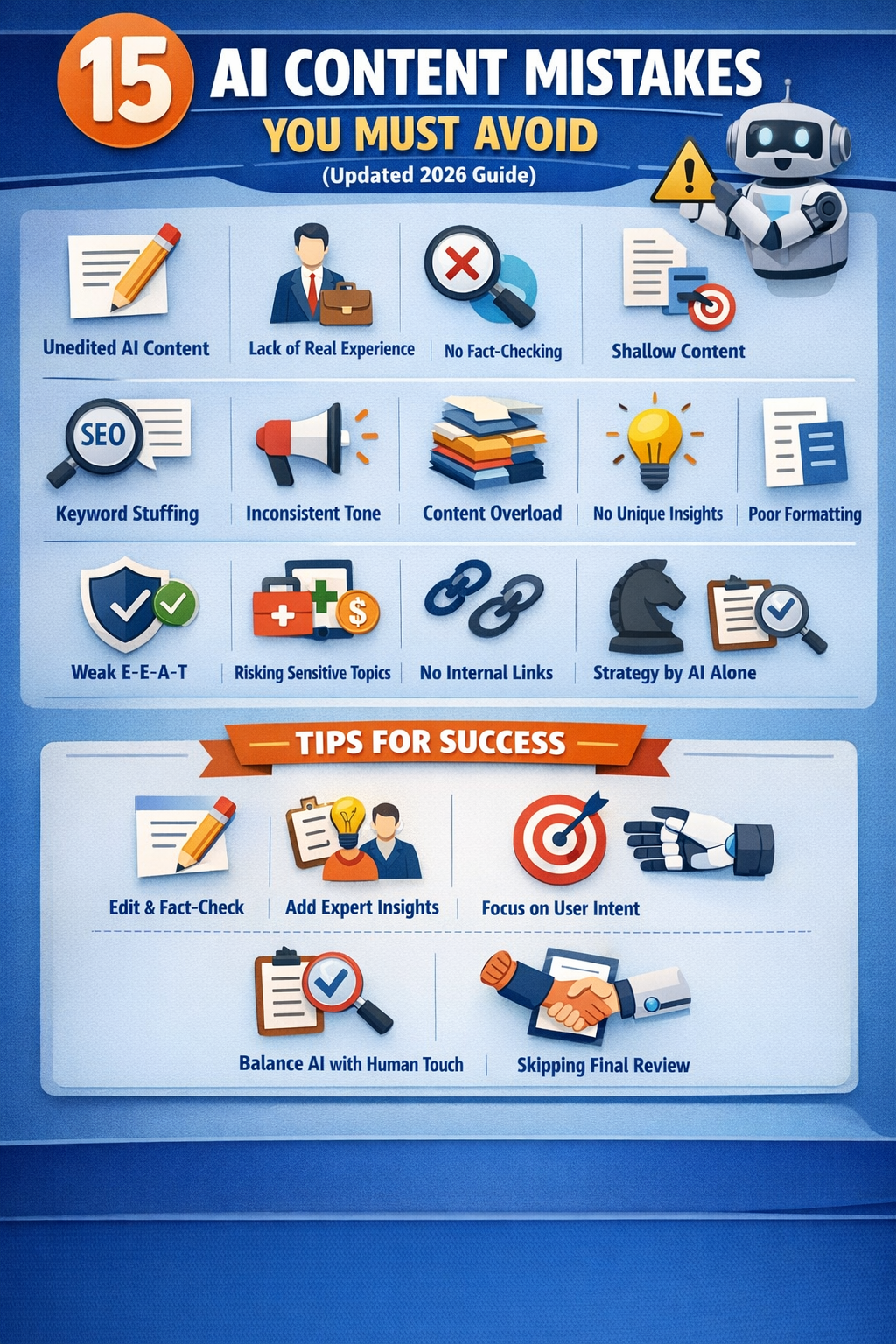
In this fully original and expanded guide, you will learn 15 major AI content mistakes, why they hurt your SEO, and how to fix them properly.
Table of Contents
ToggleWhy AI Content Mistakes Can Damage Your Website
Search engines now focus strongly on helpful and trustworthy information. According to official documentation from Google, content must demonstrate:
-
Real experience
-
Subject expertise
-
Authority
-
Trustworthiness
If your content feels robotic, shallow, or repetitive, it may not perform well — even if it is grammatically correct.
Therefore, let’s examine the most common mistakes.
1. Publishing AI Content Without Human Editing
This is the biggest mistake.
AI-generated text often:
-
Repeats ideas in different words
-
Uses generic statements
-
Lacks personality
-
Avoids strong opinions
If you publish content exactly as AI produces it, readers may lose interest quickly.
How to Fix It
Always treat AI output as a first draft. Then:
-
Rewrite key sections
-
Add insights from your own experience
-
Improve clarity
-
Remove unnecessary lines
Human editing makes content authentic.
2. Writing Without Real Experience
AI can explain topics. However, it cannot replace real-life experience.
For example:
Instead of saying, “SEO improves rankings,” write:
“In one of my eCommerce projects, optimizing product schema increased organic traffic by 28% within four months.”
Personal examples improve credibility and align with E-E-A-T standards.
3. Not Checking Facts and Statistics
AI sometimes generates outdated or incorrect data. It may even create fake studies.
This is risky.
Before publishing:
-
Verify statistics
-
Confirm updates from official sources
-
Avoid quoting data without validation
Trust is difficult to build and easy to lose.
4. Creating Surface-Level Content
Many AI articles look detailed but actually lack depth. They repeat obvious points without offering practical value.
For example:
“Content marketing is important for businesses.”
This is too general.
Instead, provide actionable steps:
-
Show frameworks
-
Add case studies
-
Share tools you use
-
Provide examples
Depth separates average content from expert-level content.
5. Ignoring Search Intent
If your article does not match what users want, it will not rank.
For example:
If someone searches “best AI writing tools,” they expect:
-
Comparisons
-
Features
-
Pricing
-
Pros and cons
They do not want a history lesson about artificial intelligence.
Therefore:
-
Study top-ranking pages
-
Understand user expectations
-
Structure your article accordingly
Intent alignment improves rankings.
6. Overusing Keywords
Some people ask AI to insert the main keyword repeatedly. This leads to keyword stuffing.
Example of poor writing:
“AI content mistakes are common AI content mistakes that AI writers make.”
This sounds unnatural.
Modern search engines are smarter. Instead:
-
Use related phrases
-
Focus on readability
-
Write naturally
SEO today rewards quality, not repetition.
7. Forgetting Brand Voice
AI usually writes in a neutral tone.
However, your brand may be:
-
Friendly
-
Professional
-
Technical
-
Inspirational
If your content tone changes randomly, readers feel disconnected.
To fix this:
-
Define your brand style
-
Edit content for consistency
-
Maintain a clear personality
Your voice builds brand identity.
8. Publishing Too Much, Too Fast
Some website owners publish 30–50 AI articles weekly.
This often results in:
-
Thin content
-
Low engagement
-
Weak authority
Instead of focusing on quantity, focus on quality.
One well-researched 2,000-word guide can outperform ten shallow articles.
9. Not Adding Unique Data or Insights
AI works based on patterns. Therefore, it often produces similar content to what already exists online.
To stand out:
-
Share original research
-
Add screenshots
-
Include industry examples
-
Provide practical workflows
Unique additions make your content different.
10. Ignoring Structure and Formatting
Even good information fails if formatting is poor.
Avoid:
-
Long paragraphs
-
Large blocks of text
-
Unclear headings
Use:
-
Short paragraphs
-
Bullet points
-
Clear H2 and H3 headings
-
Transition words like “however,” “therefore,” and “in addition”
Good formatting improves readability and user experience.
11. Not Optimizing for E-E-A-T
Experience, Expertise, Authoritativeness, and Trustworthiness matter more than ever.
To strengthen E-E-A-T:
-
Add author bio
-
Mention professional background
-
Link to credible sources
-
Include real case studies
Search engines prioritize content that feels reliable.
12. Using AI for Sensitive Topics Without Review
If you create content related to:
-
Health
-
Finance
-
Legal advice
You must review carefully.
Incorrect advice can damage credibility and even create legal issues.
Always consult verified sources for sensitive subjects.
13. Forgetting Internal Linking Strategy
AI does not understand your full website structure.
You should:
-
Link to related blog posts
-
Use descriptive anchor text
-
Create topic clusters
Internal linking improves SEO and keeps users on your website longer.
14. Depending on AI for Strategy
AI can generate content, but it cannot replace strategic thinking.
Content strategy requires:
-
Competitor analysis
-
Audience research
-
Keyword mapping
-
Conversion planning
Use AI as a tool — not as a decision-maker.
15. Skipping Final Quality Check
Before publishing, ask yourself:
-
Is this content helpful?
-
Does it solve a real problem?
-
Does it include my own insights?
-
Is it clear and easy to read?
If the answer is yes, your content is ready.
If not, revise it.
Best Way to Use AI for Content Creation
Here is a practical workflow I personally recommend:
-
Conduct manual keyword research
-
Study competitor articles
-
Create a detailed outline
-
Use AI to draft sections
-
Add personal examples
-
Fact-check data
-
Optimize headings and SEO
-
Improve readability
-
Add internal links
-
Perform final human review
This hybrid approach combines speed with quality.
Frequently Asked Questions (FAQs)
Is AI-generated content safe for SEO?
Yes, if it is helpful, original, and well-edited. Search engines evaluate usefulness, not whether AI was used.
Can search engines detect AI writing?
Search engines focus more on quality signals than detection. Low-quality content may struggle, regardless of how it was created.
How can I make AI content 100% original?
-
Rewrite sections in your own words
-
Add personal experience
-
Include unique insights
-
Run plagiarism checks
-
Avoid copying competitor structures
Should beginners use AI for blogging?
Yes, but only as an assistant. Beginners must still learn SEO basics, content structure, and audience research.
How long should AI-assisted blog posts be?
Length depends on competition and intent. However, detailed guides (1,500–2,500 words) often perform well for competitive keywords.
Final Thoughts
AI is not the problem. Misusing AI is the problem.
When you:
-
Edit carefully
-
Add experience
-
Focus on depth
-
Match user intent
-
Prioritize trust
Your AI-assisted content can rank and convert effectively.
The future of content marketing is not human vs AI.
It is human + AI.