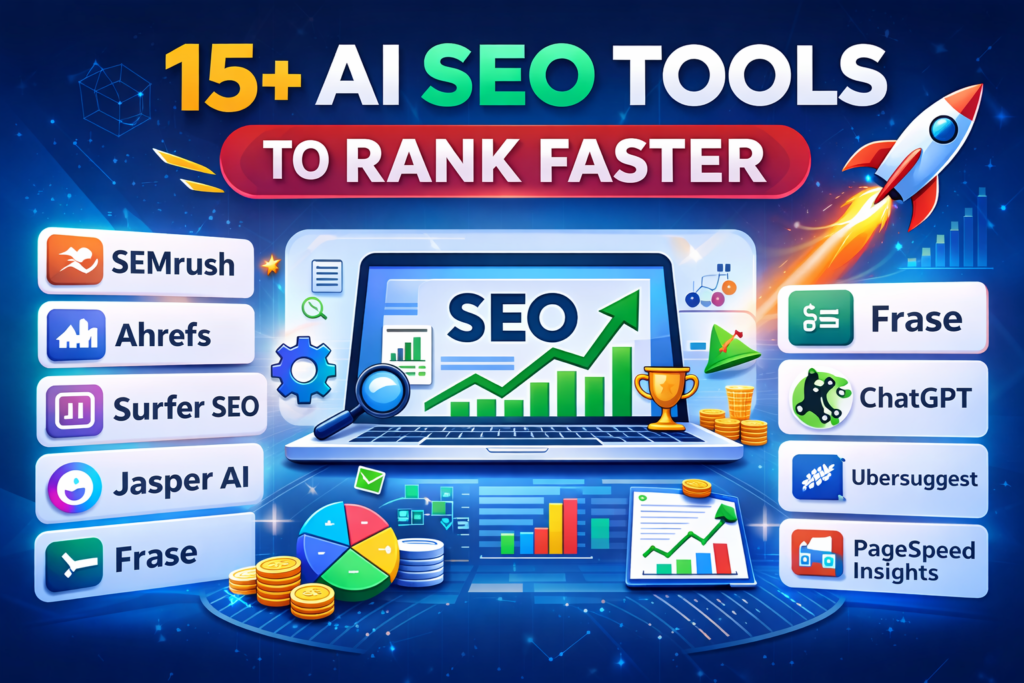

Search engine optimization is no longer manual and slow. In 2026, AI has completely changed how websites rank on Google. Today, smart marketers use artificial intelligence to research keywords, study competitors, optimize content, and fix technical issues much faster than before.
However, tools alone do not create rankings. Strategy, experience, and quality content still matter the most. After working in SEO for over 10 years, I have tested many platforms. In this guide, I will share 15+ powerful AI SEO tools that actually help websites grow faster — along with practical tips on how to use them correctly.
Let’s begin.
Why AI SEO Tools Are Important Today
Search engines now understand:
-
Search intent
-
User behavior
-
Content depth
-
Topical authority
-
Page experience
Because algorithms are smarter, traditional SEO methods are not enough. AI tools help you:
-
Discover high-intent keywords
-
Analyze top-ranking competitors
-
Build optimized content outlines
-
Improve technical performance
-
Monitor ranking growth
Most importantly, they reduce guesswork. Instead of guessing what works, you use data-backed decisions.
1. Surfer SEO
Surfer SEO is widely used for on-page optimization.
What Makes It Useful?
It analyzes the top pages ranking for your keyword. Then, it suggests:
-
Ideal word count
-
Heading structure
-
Related keywords
-
Content score
Instead of writing blindly, you write with clear data.
Best for: Bloggers, affiliate marketers, and agencies focused on content SEO.
2. SEMrush
SEMrush is an all-in-one SEO toolkit powered by machine learning.
Core Features:
-
Keyword research
-
Domain analysis
-
Backlink tracking
-
Technical site audit
-
SEO writing assistant
It also helps you discover competitor traffic sources. Therefore, you can replicate strategies that already work.
Best for: Advanced SEO professionals and marketing agencies.
3. Ahrefs
Ahrefs is highly trusted for backlink research.
Why It Stands Out:
-
Massive backlink database
-
Content gap tool
-
Keyword explorer
-
Rank tracking
If you want to build authority, strong backlinks are essential. Ahrefs helps you identify link-building opportunities faster.
4. Jasper AI
Jasper supports AI-powered content writing.
How It Helps:
-
Blog draft generation
-
Product descriptions
-
Meta titles and descriptions
-
Ad copy
However, remember this: AI-generated content must always be edited. Adding your personal experience improves quality and trust.
5. Frase
Frase focuses on answering user intent.
It analyzes search results and identifies:
-
Common questions
-
Important topics
-
Missing subheadings
As a result, your content becomes more complete and helpful.
6. Clearscope
Clearscope is designed for content optimization.
It provides:
-
Relevance scoring
-
Keyword suggestions
-
Content grading
This tool ensures your article covers a topic deeply instead of just repeating keywords.
7. MarketMuse
MarketMuse helps build topical authority.
Key Benefits:
-
Content planning
-
Authority mapping
-
AI topic suggestions
-
Competitive analysis
If you want to dominate a niche instead of ranking one page, this tool is very powerful.
8. Rank Math AI
Rank Math is a WordPress plugin with AI support.
It Offers:
-
On-page SEO score
-
Schema markup
-
Meta tag optimization
-
Content suggestions
It is beginner-friendly and cost-effective.
9. Yoast SEO Premium
Yoast helps improve readability and SEO structure.
It checks:
-
Sentence length
-
Keyword placement
-
Internal linking
-
SEO basics
Although simple, it works well for bloggers who want guidance while writing.
10. ChatGPT for SEO Strategy
OpenAI developed ChatGPT, which can assist with:
-
Keyword clustering
-
Topic ideas
-
FAQ generation
-
Content outlines
-
Schema ideas
However, always verify facts and add original insights.
11. Screaming Frog
Screaming Frog is excellent for technical audits.
It detects:
-
Broken links
-
Redirect chains
-
Duplicate content
-
Missing tags
Technical health directly affects ranking potential.
12. Google Search Console
Google Search Console is a free but powerful tool.
It shows:
-
Search queries
-
Click-through rate
-
Indexing issues
-
Performance data
You should check it weekly to monitor growth.
13. Google Analytics 4
Google Analytics (GA4) tracks user behavior.
It helps you understand:
-
Bounce rate
-
Engagement time
-
Traffic sources
-
Conversion paths
Data analysis improves decision-making.
14. Ubersuggest
Ubersuggest is suitable for beginners.
It offers:
-
Keyword suggestions
-
SEO difficulty score
-
Site audit
-
Content ideas
It is budget-friendly and easy to use.
15. Google PageSpeed Insights
Google PageSpeed Insights evaluates website speed.
Page speed affects rankings and user experience. This tool suggests:
-
Image compression
-
Script reduction
-
Core Web Vitals fixes
16. NeuronWriter
NeuronWriter combines NLP optimization with AI writing.
It helps with:
-
SERP comparison
-
Keyword coverage
-
Content scoring
Ideal for content-focused websites.
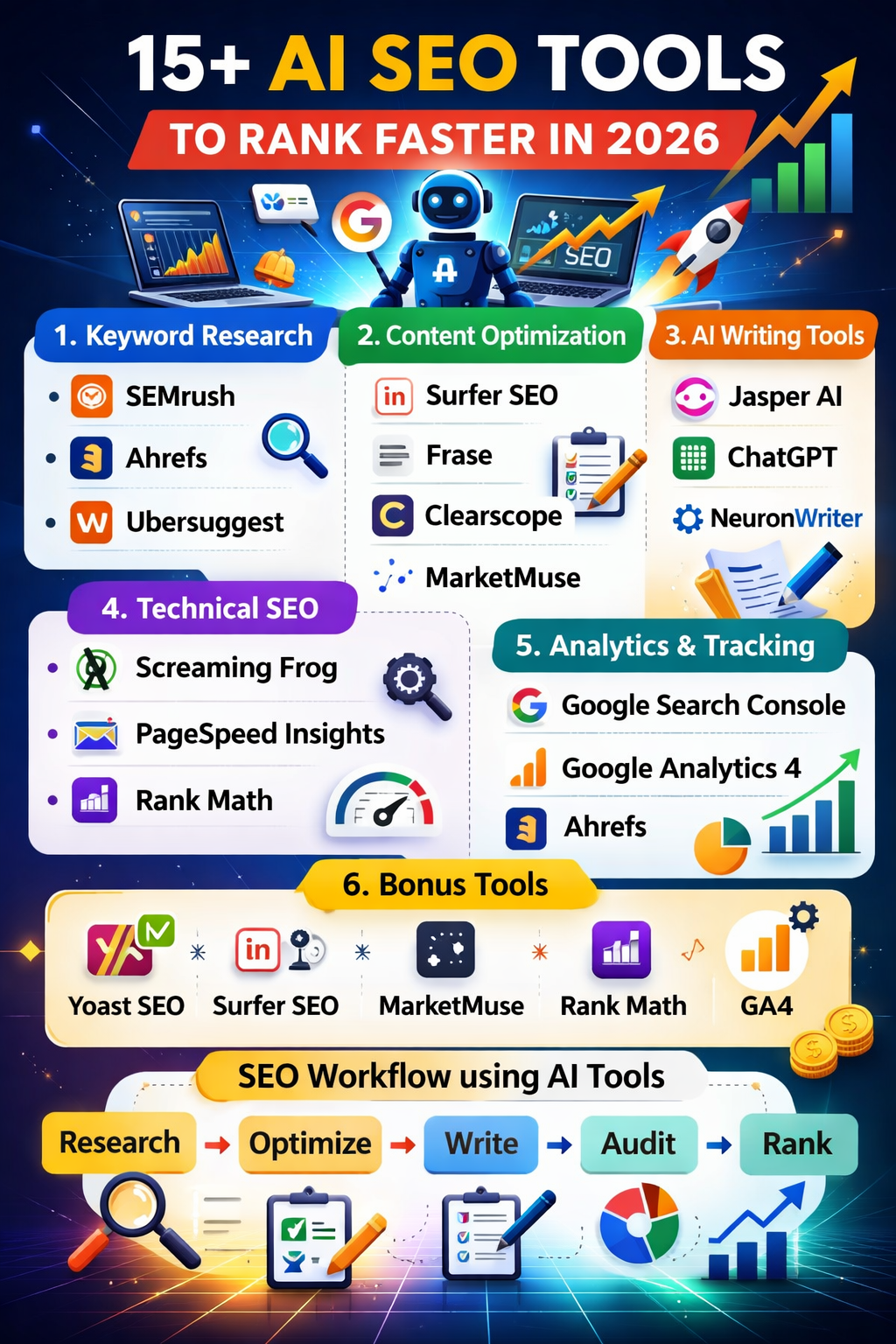
How to Combine AI Tools for Faster Rankings
Using one tool is not enough. Smart SEO professionals combine tools strategically.
Step 1: Research
Start with SEMrush or Ahrefs to find profitable keywords.
Step 2: Analyze SERP
Use Surfer SEO or Frase to understand ranking patterns.
Step 3: Create Content
Draft with AI tools but improve manually.
Step 4: Optimize Technical Issues
Run audits with Screaming Frog and PageSpeed Insights.
Step 5: Track & Improve
Monitor progress using Google Search Console and GA4.
SEO is a continuous process. Improvement never stops.
Real-World Advice from 10+ Years in SEO
After working on multiple niches, here is what truly works:
-
Focus on search intent, not just keywords
-
Build topic clusters
-
Update old content regularly
-
Improve internal linking
-
Earn natural backlinks
-
Track data weekly
AI tools help speed up these tasks, but strategy remains human-driven.
Common Mistakes to Avoid
Many website owners misuse AI tools. Avoid these errors:
-
Publishing unedited AI content
-
Over-optimizing keywords
-
Ignoring user experience
-
Forgetting mobile optimization
-
Copying competitors
Always prioritize helpful content over shortcuts.
Frequently Asked Questions (FAQs)
1. Can AI tools guarantee rankings?
No tool can guarantee rankings. They improve efficiency, but strategy and quality matter most.
2. Are free SEO tools enough?
Free tools like Google Search Console and PageSpeed Insights are powerful. However, paid tools provide deeper analysis.
3. Is AI-generated content allowed by Google?
Yes, as long as it is helpful, accurate, and written for users — not just search engines.
4. Which AI SEO tool is best for small businesses?
Ubersuggest and Rank Math are affordable options for small websites.
5. How fast can I see SEO results?
Most websites see improvements within 3–6 months. Competitive niches may take longer.
Final Thoughts
AI has transformed SEO completely. Today, ranking faster is possible if you combine:
-
Smart keyword research
-
Data-driven content creation
-
Technical optimization
-
Continuous monitoring
-
Real experience and expertise
Tools are assistants. Your knowledge builds authority.
If you use these 15+ AI SEO tools correctly, you can create stronger content, improve rankings, and grow your website sustainably in 2026 and beyond.