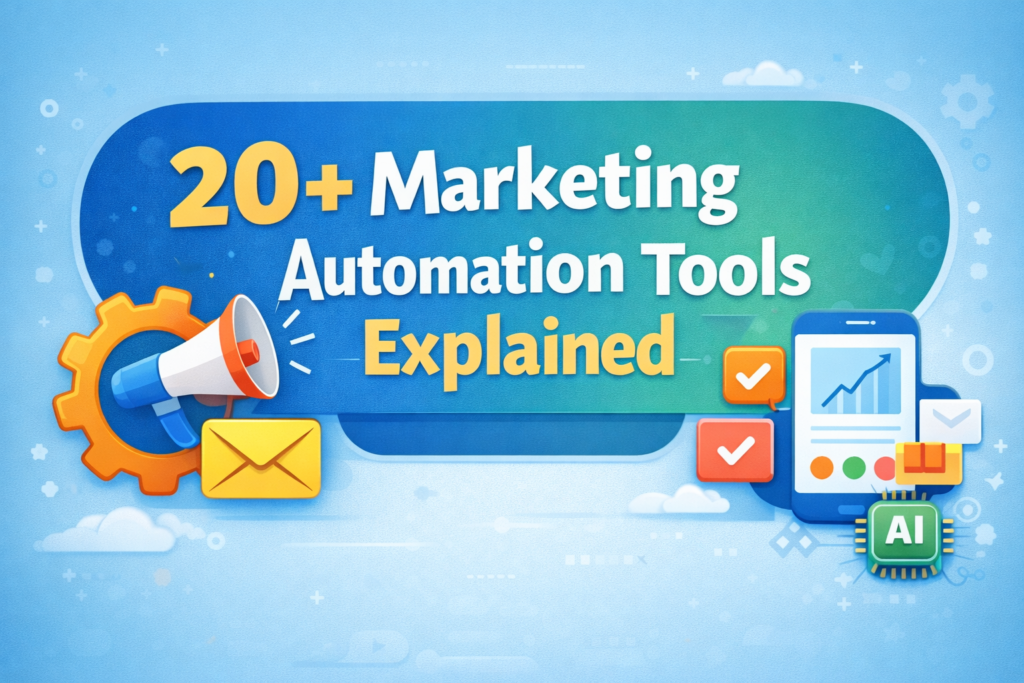

Marketing today is not about sending random emails or posting on social media without strategy. It is about sending the right message, to the right person, at the right time. This is where marketing automation tools help.
With over 10 years of experience in SEO and digital marketing, I have tested many automation platforms. Some are powerful for email marketing. Others are best for CRM, social media, eCommerce, or lead nurturing. In this guide, I will explain 20+ marketing automation tools in simple English, so you can choose the right one for your business.
What Is Marketing Automation?
Marketing automation is software that helps businesses automate repetitive marketing tasks. For example:
-
Sending welcome emails
-
Nurturing leads
-
Scheduling social media posts
-
Tracking website visitors
-
Scoring leads
-
Running drip campaigns
Instead of doing everything manually, automation saves time and improves results.
Why Marketing Automation Is Important
Before we explore the tools, let’s understand the benefits:
-
Saves time and effort
-
Improves lead management
-
Increases conversion rates
-
Personalizes customer experience
-
Tracks and measures campaign performance
-
Improves ROI
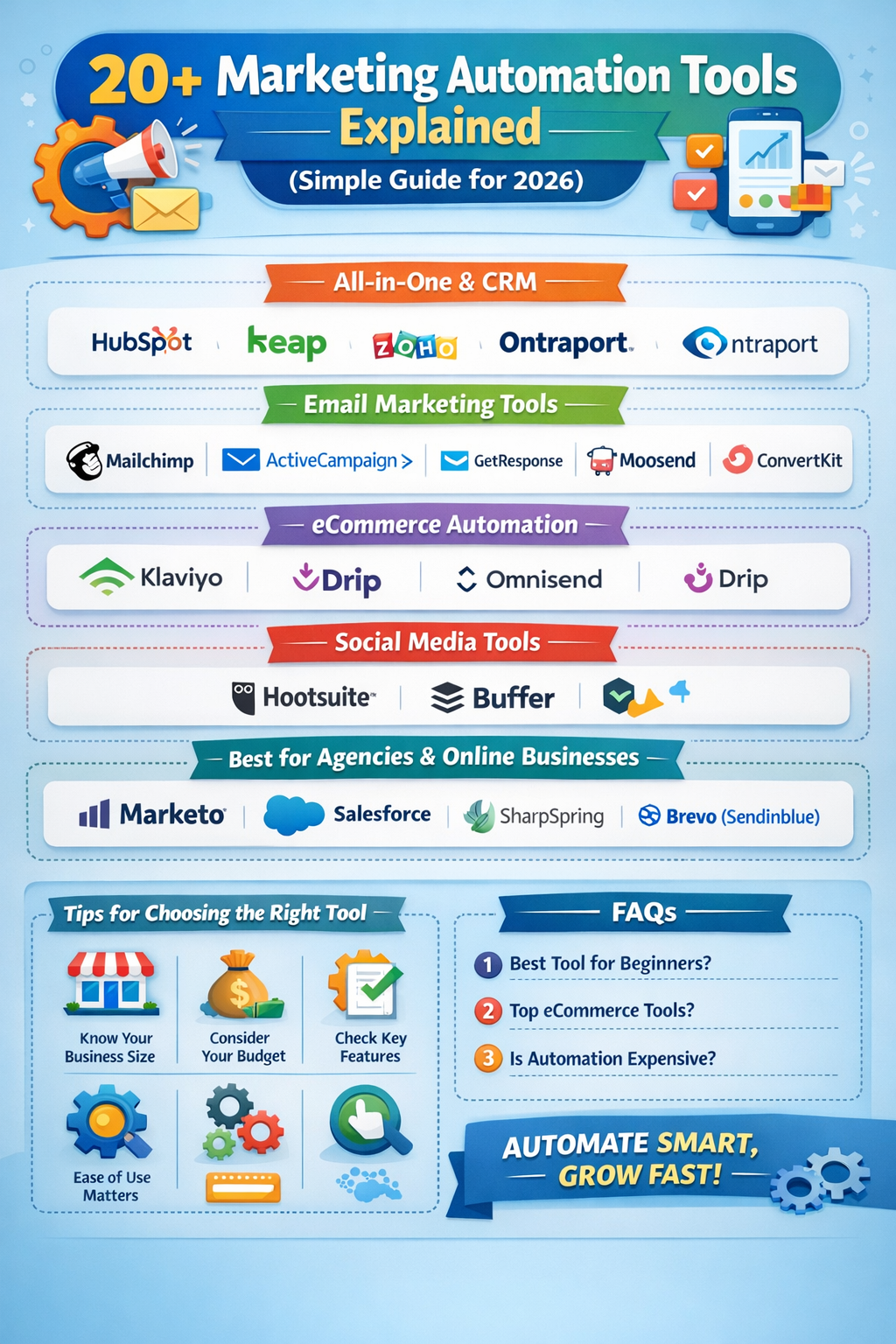
Now, let’s explore the best tools available.
1. HubSpot
Best for: All-in-one marketing automation
HubSpot is one of the most popular platforms. It offers:
-
Email marketing
-
CRM
-
Landing pages
-
Lead scoring
-
Workflow automation
-
Analytics
It is perfect for small to medium businesses. Moreover, its free CRM is very powerful.
2. Mailchimp
Best for: Email marketing beginners
Mailchimp started as an email tool, but now it offers:
-
Email automation
-
Audience segmentation
-
Basic CRM
-
Landing pages
-
Social ads
It is simple and affordable. Therefore, it is great for startups.
3. ActiveCampaign
Best for: Advanced email automation
ActiveCampaign is strong in:
-
Behavioral automation
-
Advanced workflows
-
CRM integration
-
SMS marketing
If you want powerful email sequences, this is a great choice.
4. Marketo
Best for: Enterprise businesses
Marketo, owned by Adobe, is ideal for large companies. It offers:
-
Lead management
-
Account-based marketing
-
Advanced analytics
-
Multi-channel campaigns
However, it is expensive and complex.
5. Salesforce Marketing Cloud
Best for: Large organizations
This tool integrates deeply with Salesforce CRM. It supports:
-
Email
-
SMS
-
Social media
-
Customer journeys
-
AI personalization
It is powerful but best suited for enterprises.
6. GetResponse
Best for: Email + webinars
GetResponse offers:
-
Email marketing
-
Automation workflows
-
Webinar hosting
-
Landing pages
-
Sales funnels
It is a good all-in-one option for small businesses.
7. Sendinblue (Brevo)
Best for: Budget-friendly automation
Brevo includes:
-
Email marketing
-
SMS campaigns
-
Automation workflows
-
CRM
It is affordable and suitable for growing businesses.
8. Drip
Best for: eCommerce brands
Drip focuses on:
-
Customer journeys
-
Cart abandonment emails
-
Personalization
-
Revenue tracking
If you run an online store, this is a strong choice.
9. Klaviyo
Best for: Shopify and eCommerce
Klaviyo is popular among Shopify users. It provides:
-
Email and SMS automation
-
Advanced segmentation
-
Predictive analytics
It is highly data-driven.
10. Zoho Marketing Automation
Best for: Small and mid-size companies
Zoho offers:
-
Lead tracking
-
Email campaigns
-
Social media integration
-
CRM sync
It is cost-effective and easy to use.
11. Pardot
Best for: B2B marketing
Pardot helps with:
-
Lead scoring
-
B2B email campaigns
-
Sales alignment
-
ROI reporting
It is powerful for business-to-business companies.
12. Omnisend
Best for: eCommerce multi-channel marketing
Omnisend supports:
-
Email
-
SMS
-
Push notifications
-
Automated product recommendations
It is easy to set up for online stores.
13. Constant Contact
Best for: Small local businesses
Constant Contact offers:
-
Email marketing
-
Social ads
-
Event marketing
-
Automation sequences
It is beginner-friendly.
14. Moosend
Best for: Affordable email automation
Moosend includes:
-
Drag-and-drop email builder
-
Automation workflows
-
Real-time analytics
It is budget-friendly and easy to manage.
15. ConvertKit
Best for: Bloggers and creators
ConvertKit helps:
-
Build email lists
-
Automate sequences
-
Sell digital products
It is simple and focused on content creators.
16. Keap
Best for: Small business CRM automation
Keap combines:
-
CRM
-
Email automation
-
Invoicing
-
Appointment booking
It is helpful for service-based businesses.
17. SharpSpring
Best for: Agencies
SharpSpring offers:
-
Lead scoring
-
Dynamic forms
-
Behavioral tracking
-
CRM
It is popular among marketing agencies.
18. Ontraport
Best for: Online businesses
Ontraport provides:
-
CRM
-
Email automation
-
Membership sites
-
Payment processing
It is strong for digital entrepreneurs.
19. Hootsuite
Best for: Social media automation
Hootsuite allows:
-
Scheduling posts
-
Monitoring engagement
-
Analytics
-
Team collaboration
It is ideal for social media marketers.
20. Buffer
Best for: Simple social scheduling
Buffer helps with:
-
Post scheduling
-
Content planning
-
Performance tracking
It is easy and affordable.
21. Autopilot (Ortto)
Best for: Visual customer journeys
Autopilot (now Ortto) offers:
-
Visual journey builder
-
Multi-channel messaging
-
Analytics
It is great for visual workflow lovers.
How to Choose the Right Marketing Automation Tool
Choosing the right tool depends on:
1. Your Business Size
-
Small business → Mailchimp, Zoho, Constant Contact
-
eCommerce → Klaviyo, Drip, Omnisend
-
Enterprise → Marketo, Salesforce Marketing Cloud
2. Your Budget
Some tools are affordable. Others are expensive enterprise solutions.
3. Required Features
Ask yourself:
-
Do you need CRM?
-
Do you need SMS?
-
Do you sell online?
-
Do you need advanced reporting?
4. Ease of Use
If your team is small, choose a simple interface.
Common Mistakes to Avoid
Even the best tool will not work if used incorrectly. Avoid these mistakes:
-
Sending too many emails
-
Not segmenting your audience
-
Ignoring analytics
-
Not testing automation workflows
-
Overcomplicating campaigns
Start simple. Then improve gradually.
Final Thoughts
Marketing automation is no longer optional. It is essential for businesses that want to grow faster and smarter. However, the best tool depends on your goals.
If you are a beginner, start with Mailchimp or Zoho. If you run an eCommerce store, choose Klaviyo or Drip. For enterprise-level marketing, consider Marketo or Salesforce Marketing Cloud.
Remember, automation saves time. But strategy drives results.
Frequently Asked Questions (FAQs)
1. What is the best marketing automation tool for beginners?
Mailchimp and Zoho Marketing Automation are great for beginners because they are easy to use and affordable.
2. Which tool is best for eCommerce?
Klaviyo, Drip, and Omnisend are excellent for eCommerce automation.
3. Is marketing automation expensive?
It depends on the tool. Some start at low monthly costs, while enterprise tools can be expensive.
4. Do small businesses need marketing automation?
Yes. Even small businesses benefit from automated emails, follow-ups, and lead tracking.
5. Can marketing automation increase sales?
Yes. When used correctly, automation improves personalization, engagement, and conversions.