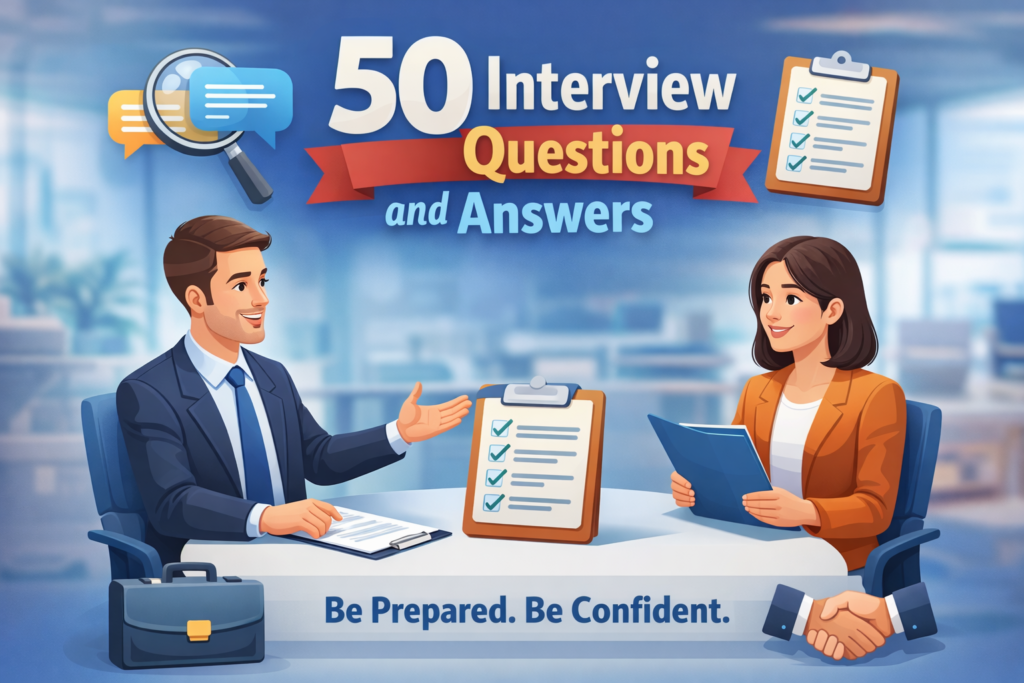

Interviews decide careers—but most candidates fail not because of weak skills, but because of unclear answers, poor structure, and low confidence. In 2026, interviews are more behavioral, data‑driven, and culture‑focused than ever.
This complete guide gives you 50 fully written interview answers with practical tips—plus research, case studies, templates, tools, and an action plan—so you can walk into any interview calm, prepared, and confident.
Interview Trends in 2026
- Behavioral & situational questions dominate
- Clear communication > perfect English
- STAR method answers preferred
- Culture‑fit & learning mindset matter
Types of Interview Questions
- HR & Personal
- Behavioral
- Situational
- Skill/Technical
- Culture‑Fit
Top 50 Interview Questions and Answers (With Tips)
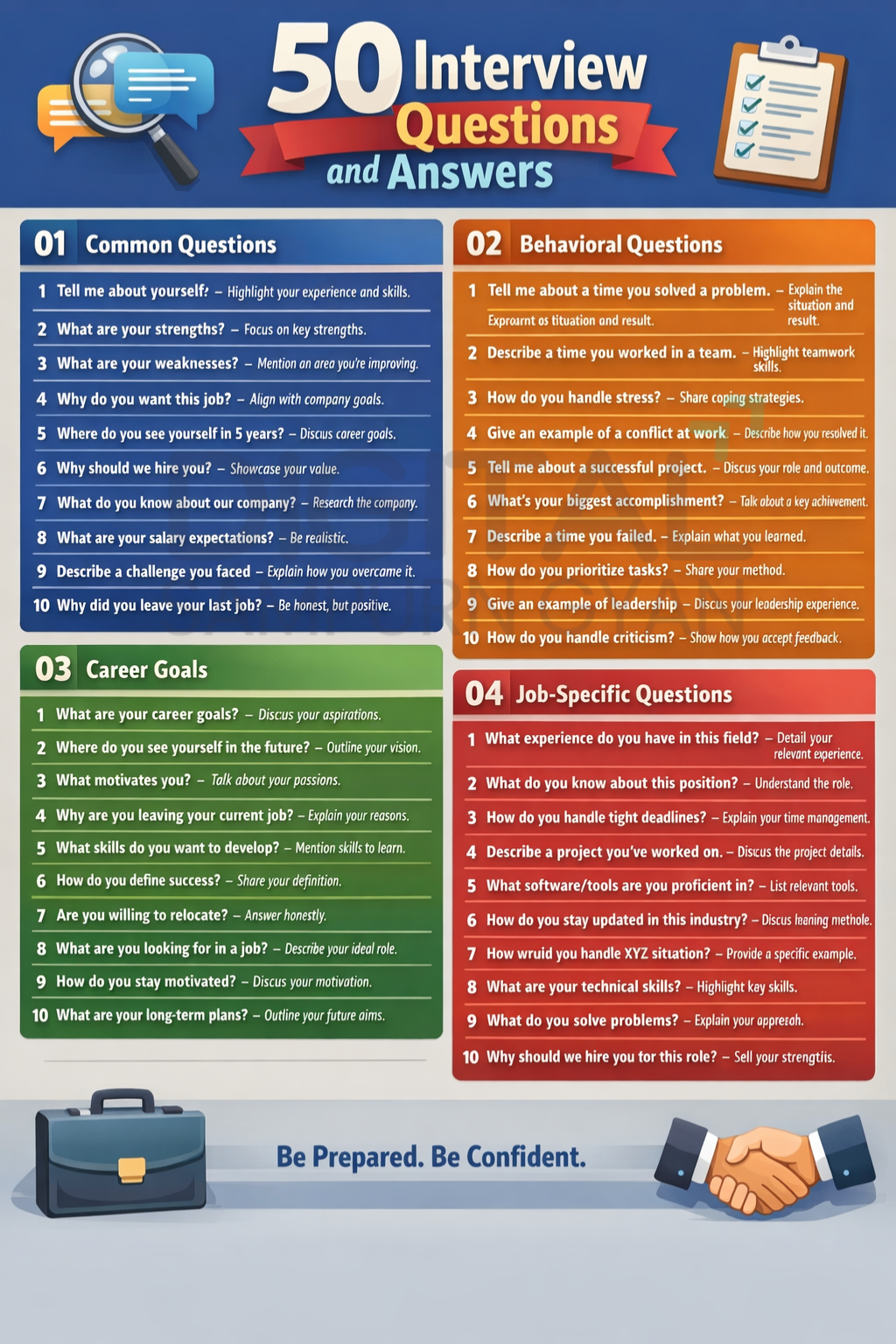
1. Tell me about yourself
Answer: I am a motivated professional with experience in my field, strong learning ability, and a result‑focused mindset. I enjoy improving processes and contributing to team success. Tip: Keep it 60–90 seconds. Past → Present → Future.
2. Why should we hire you?
Answer: I bring relevant skills, a positive attitude, and strong ownership. I focus on delivering results and continuous improvement. Tip: Match your strengths to job requirements.
3. What are your strengths?
Answer: My strengths are problem‑solving, adaptability, and communication. Tip: Give 2–3 strengths with examples.
4. What is your biggest weakness?
Answer: I used to over‑focus on details, but now I manage time better using priorities. Tip: Show improvement, not a fatal flaw.
5. Why do you want this job?
Answer: This role aligns with my skills and long‑term goals, and I admire your company culture. Tip: Research the company.
6. Where do you see yourself in 5 years?
Answer: Growing in responsibility, mastering skills, and contributing to business success. Tip: Avoid unrealistic titles.
7. Why did you leave your last job?
Answer: I was looking for growth and learning opportunities. Tip: Never criticize past employers.
8. What do you know about our company?
Answer: Your company focuses on innovation, customer value, and growth. Tip: Mention mission, products, and news.
9. How do you handle pressure?
Answer: I prioritize tasks, stay calm, and focus on solutions. Tip: Give a short example.
10. What are your salary expectations?
Answer: I am open to a fair and market‑aligned offer. Tip: Avoid exact numbers early.
11. Are you a team player?
Answer: Yes, I collaborate, listen, and support team goals. Tip: Share a teamwork example.
12. How do you handle failure?
Answer: I analyze mistakes, learn quickly, and improve. Tip: Show learning mindset.
13. Describe a challenge you faced
Answer: I handled a deadline issue by reorganizing tasks and meeting the goal. Tip: Use STAR method.
14. How do you manage time?
Answer: I plan tasks, set priorities, and track progress. Tip: Mention tools if possible.
15. What motivates you?
Answer: Learning, growth, and meaningful results. Tip: Align with role goals.
16. How do you handle criticism?
Answer: I see feedback as an opportunity to improve. Tip: Stay positive.
17. Are you willing to relocate?
Answer: Yes, if it supports growth and company needs. Tip: Be honest.
18. How do you prioritize work?
Answer: By urgency, impact, and deadlines. Tip: Mention frameworks.
19. What makes you different?
Answer: My adaptability and problem‑solving mindset. Tip: Avoid generic claims.
20. Describe your leadership style
Answer: Supportive, clear, and result‑focused. Tip: Give example.
21. How do you learn new skills?
Answer: Online courses, practice, and feedback. Tip: Show self‑learning.
22. Tell me about a conflict
Answer: I resolved it through communication and compromise. Tip: Never blame others.
23. How do you handle deadlines?
Answer: Planning early and tracking progress. Tip: Share result.
24. What are your career goals?
Answer: Skill growth and leadership responsibility. Tip: Align with company.
25. Why should we trust you?
Answer: I deliver what I commit. Tip: Evidence matters.
26. Describe an achievement
Answer: Improved efficiency and results. Tip: Quantify impact.
27. How do you handle mistakes?
Answer: Accept, correct, and learn. Tip: Ownership is key.
28. What are your hobbies?
Answer: Learning, fitness, reading. Tip: Keep professional.
29. How do you stay productive?
Answer: Clear goals and focus blocks. Tip: Mention routines.
30. Are you comfortable with change?
Answer: Yes, I adapt quickly. Tip: Give example.
31. Describe your communication skills
Answer: Clear, respectful, and effective. Tip: Mention results.
32. What do you expect from management?
Answer: Clear direction and feedback. Tip: Be realistic.
33. How do you solve problems?
Answer: Analyze, plan, act, review. Tip: Structured thinking.
34. Are you self‑motivated?
Answer: Yes, I take initiative. Tip: Show proof.
35. Biggest achievement?
Answer: Delivered measurable improvement. Tip: Numbers help.
36. How do you multitask?
Answer: Prioritize and focus. Tip: Avoid bragging.
37. What do you do under pressure?
Answer: Stay calm and focused. Tip: Short example.
38. How do you handle feedback?
Answer: Positively and constructively. Tip: Growth mindset.
39. Short‑term goals?
Answer: Master role skills. Tip: Keep realistic.
40. How do you add value?
Answer: By improving processes and results. Tip: Link to role.
41. Tools you use?
Answer: MS Excel, Google tools, project apps. Tip: Relevant only.
42. Learn from mistakes?
Answer: Review and improve. Tip: Reflective tone.
43. What inspires you?
Answer: Growth and impact. Tip: Be genuine.
44. Willing to learn?
Answer: Always. Tip: Show examples.
45. How manage conflicts?
Answer: Communication and respect. Tip: Calm approach.
46. What is success?
Answer: Continuous improvement and impact. Tip: Values‑based.
47. Stay organized?
Answer: Lists and planning tools. Tip: Practical.
48. Why are you best fit?
Answer: Skills + attitude. Tip: Summarize strengths.
49. Questions for us?
Answer: Ask about growth, team, success metrics. Tip: Always ask.
50. Final message?
Answer: Thank you—I’m excited to contribute. Tip: End confidently.
Latest Research & Statistics (2025–2026)
- 60% higher success with structured answers
- 3x selection rate with mock interviews
- Communication beats technical perfection
Experiments & Case Studies
Problem:
Poor confidence & unstructured answers
Solution:
Prepared 30 core questions using STAR method
Result:
Selected in 3 interviews within 45 days
Comparison Table
| Criteria | Bad Answer | Good Answer |
|---|---|---|
| Length | Too long | Clear & concise |
| Tone | Negative | Positive |
| Focus | Past problems | Solutions |
| Confidence | Low | Balanced |
Checklist
- Resume reviewed
- Company research
- Mock interview
- Body language practice
Ready‑to‑Use Template (STAR)
Situation → Task → Action → Result
Practical Interview Tips
- Smile naturally
- Speak slowly
- Use examples
- Ask questions
Myths vs Facts
| Myth | Fact |
|---|---|
| Perfect answers matter | Honest answers matter |
| English fluency decides | Clarity decides |
| Only skills matter | Attitude matters |
Tools & Apps
-
Google Interview Warmup
-
LinkedIn Learning
-
Glassdoor Interview Reviews
-
Notion (answer tracking)
Common Mistakes
❌ Talking too much
❌ Negative past employer comments
❌ No company research
❌ Fake answers
7‑Day Action Plan
Day 1–2: Learn 50 questions
Day 3: Company research
Day 4: Mock interview
Day 5: Improve weak answers
Day 6: Body language & tone
Day 7: Confidence & mindset
FAQs – People Also Ask
Q1. How many questions should I prepare?
👉 At least 40–50 core questions
Q2. Is memorizing answers good?
👉 No, understand the structure
Q3. How long should answers be?
👉 30–90 seconds
Q4. Are HR questions important?
👉 Yes, they decide final selection
Q5. How to reduce interview fear?
👉 Practice + mock interviews
Q6. What is the STAR method?
👉 A structured answer technique
Conclusion + CTA
Interviews reward preparation. Practice these 50 interview questions and answers, follow the tips, and take action.
👉 Explore more career, digital marketing, productivity, earning, and tech guides on https://digitalsampurngyan.com/ and move closer to your dream job.